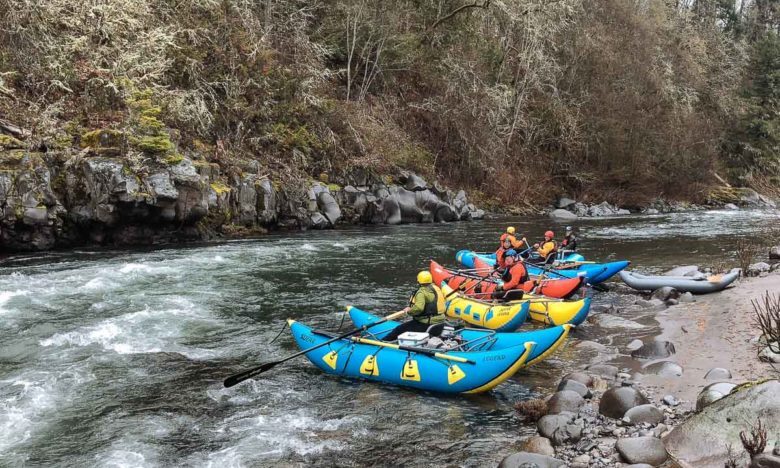
Imagine this, you are rowing a raft down a stretch of river you have never seen before, and up ahead you spot a massive strainer on river right. The lead boat is positioned in an eddy, enthusiastically pointing to “Get Left!” You are nervous and don’t want to hit the strainer; muscle memory takes over. You point your boat to the left, and push hard to get there, gaining as much speed as you can to make it clear of the strainer. But the current is stronger and pushing to river right, and you don’t make it far enough to the left. Now, you’re stuck on a strainer. Sh*t.
Now you’re left asking yourself, “What could I have done differently?”
The answer: Row Defensively.
“When first learning to navigate through rapids, the most effective technique/strategy is to pull because pulling is a stronger stroke and because pulling slows things down. Rare is the beginning rower who says ‘I think I am too strong.’ Rarer still is the one who says ‘I want everything to happen faster.’” – Steve Welch, Rowing School Instructor
If you’ve ever taken one of our Class III Rowing Schools, you’ve probably heard the phrase “Be Defensive!” more times than you can count. I’ve been instructing our Class III Rowing Schools for three years now, and the students that experience the most success and transformation in their rowing are students who embrace the defensive style of rowing.
But, What Even is “Defensive Rowing?”
Defensive rowing isn’t a specific technique, it’s a mindset you can bring to the river. Defensive rowing means setting yourself up to stay off of obstacles and hazards in the river. It usually means slowing down your boat so that you have more time to respond to the changing river, and often it means pivoting your boat defensively away from whatever you want to avoid.
Why Row Defensively?
Rowing a raft is a unique whitewater experience; unlike a paddle boat or a kayak, it can be difficult to charge up enough speed to propel an oar boat where you want to go. Propelling your raft where you want to go, which a rower can achieve by either pushing or pulling downstream, is a more aggressive style of rowing. With a larger boat and less power, compared to kayaking or paddle boating, a defensive approach to whitewater can be incredibly beneficial, if not necessary, for rowers. In particular, rowers who are learning or on an unfamiliar river.
Defensive rowing, when done successfully, allows a boater to maneuver rapids in a conservative manner and not expose themselves to dangerous positions or hazards. We advocate for defensive rowing as a foundation for our students because it tends to bring more success to boaters and also allows them to not work as hard. Also, pulling away from obstacles puts your boat in a better position if things go wrong; if a boater misses their move while pulling, they’ll hit the obstacle with the front of their boat, not the side.
“Look, if you want to look like you know what you’re doing, enter rapids defensively; it gives you more time to adjust the angle, speed, and location of your raft.” – Daniel Stillman, Rowing School Instructor
How to Defensively Row
The main techniques needed to successfully row defensively are:
- Identifying and anticipating hazards in the water
- Identifying the current that leads towards hazards
- Pivoting your boat
- Setting a 45-90 degree angle to the current
- Maintaining that angle
- Pulling, if needed!
This Order Matters
First, you need to know what you’re trying to avoid and which currents are pushing towards those obstacles vs. which currents are flowing away from the obstacles. Then, you need to position your boat so that you have an effective angle to that obstacle; just pointing your boat at an obstacle and pulling without a proper angle is not going to be effective.
After pivoting your boat, you need to have enough boat awareness to understand roughly what angle your boat is at in relation to the current, and you need to have the ability to maintain that angle until you’ve successfully made the move you want to make.
Finally, after all of that, you pull with your oars, if you need to, to stay away from the hazard. Our students have been blown away by how little actual pulling they need to do when they use the proper defensive angle.

And that’s defensive rowing! Mastering this approach to whitewater takes constant practice, which is what students get the opportunity to do in our Class III schools, but understanding the theory behind Defensive Rowing before actually sitting in the boat can be helpful.
What About Pushing?
This is the number question we get when we talk about defensive rowing. “But I like to push, and I don’t want to fight against the force of the water.” Pushing is a valuable skill that has its time and place.
Pros:
- You don’t have to fight against the force of the current
- You’re looking in the direction you’re trying to go, which can feel more intuitive
- You’re gaining speed, which can help your boat pierce through features like waves and holes.
Cons:
- You are relying on your body’s weaker muscles, whereas pulling allows you to use your core, legs, and back.
- If you don’t make your move while pushing, you hit your obstacle sideways, which is very unstable.
- You give yourself less time to respond to the river around you.
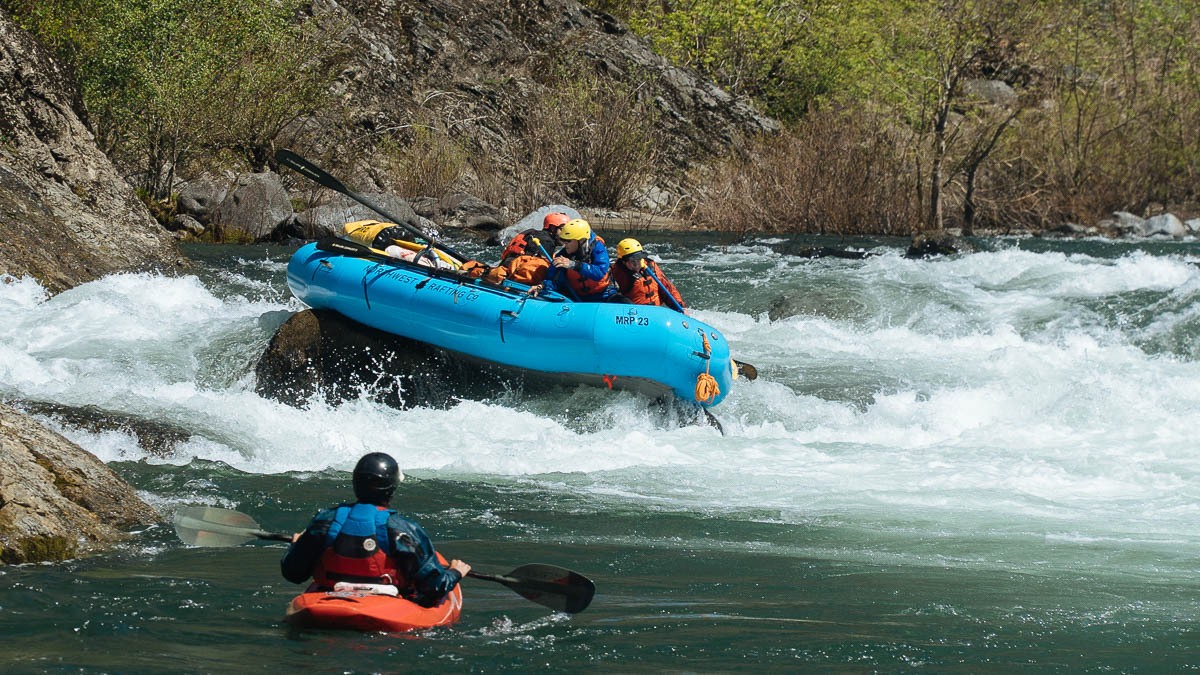
At the end of the day, we want our students to have a solid foundation of defensive rowing so that when they need to make an important, consequential move, they can be confident in their ability to pivot and pull their boat away from the hazard. That way, when you see that strainer on river right, and the lead boat is telling you to get left. You don’t panic. You know you can point your boat at that strainer, find an effective angle, and slow down the entire process by pulling your way, effectively, away from the strainer. Learning how to defensively row first, establishing pulling away from the line to danger as the default, tends to give beginner boaters more confidence and success on the river.