From the instant we landed in Bhutan, my brain was on overdrive. Everything was beautiful and new, and I wanted to soak up every detail. It felt incredibly overwhelming, in the exciting way that has come to define the experiences I cherish most. I wanted to stare at the Himalayas, learn Dzongkha (the national language), smile at everyone, spin every prayer wheel, learn about every Buddhist deity and historical figure, and most importantly, pet every dog. Buzzing. Eventually, I started to become familiar with a handful of things in Bhutan, and that helped me to feel one step closer to grounded amidst the excitement. I started to recognize the stupas, religious structures that enshrine sacred relics, and started to sense which dogs wanted attention and which ones wanted to be left alone.
By the morning of day two, I could confidently say “hello” and “thank you.” After a couple visits into the various temples, monasteries, and dzongs of Bhutan, I could pick out motifs in the thankgas, or traditional paintings, that are on nearly every wall. Bhavachakra, or The Wheel of Life, stood out to me from the beginning; it is a vibrant, detailed painting, centrally located at the entrance of nearly every temple. I dedicated myself to learning the story and message behind this painting. Here’s what I have pieced together; spoiler alert, I learned a lot, but not everything.
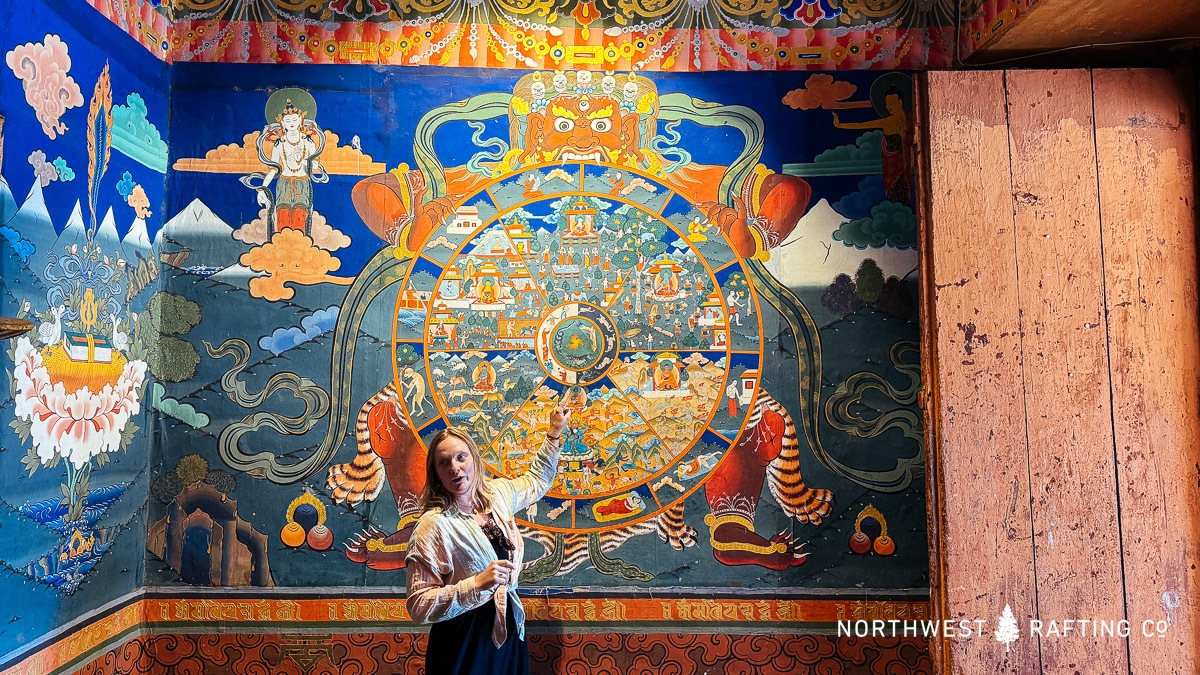
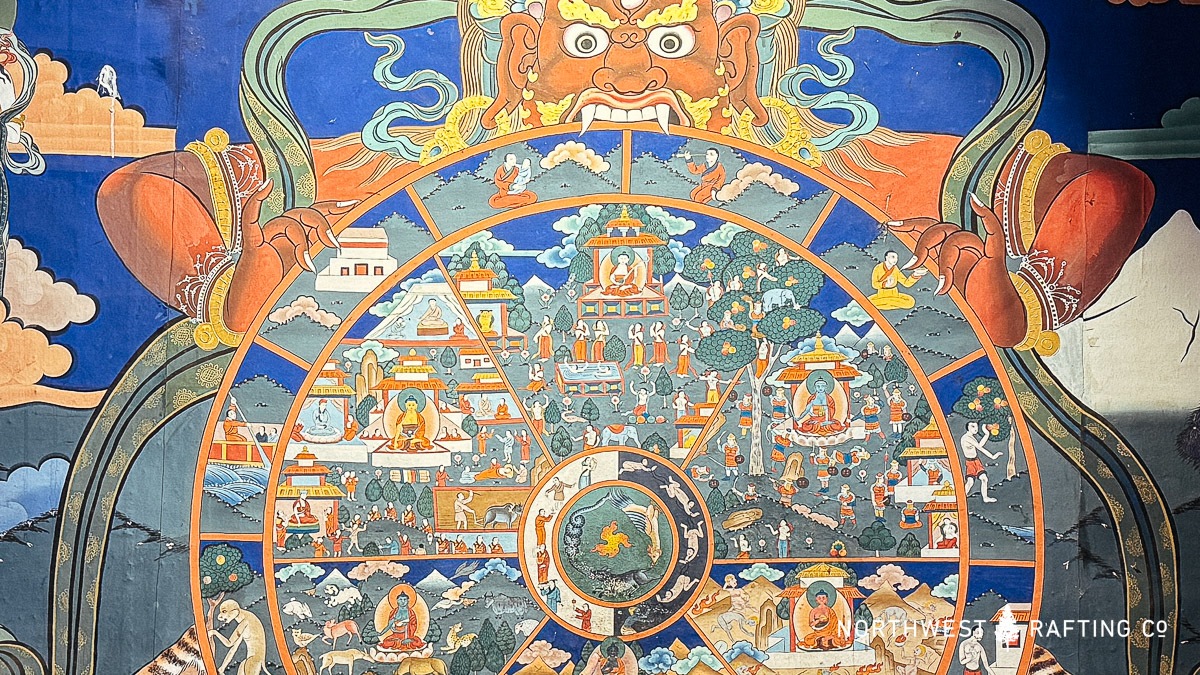
The Wheel of Life is made up of four concentric circles and clutched in the jaws of Yama, the Buddhist God of Death. It’s important to understand that all of the layers within the Wheel of Life are related and interdependent; we must see all parts of the wheel within the context of Buddhism and as connected to the other aspects and layers of the wheel. That being said, it’s helpful to look at each circle, understand the specific imagery and stories told, and then connect it to the broader story of the Bhavachakra.
The Three Poisons
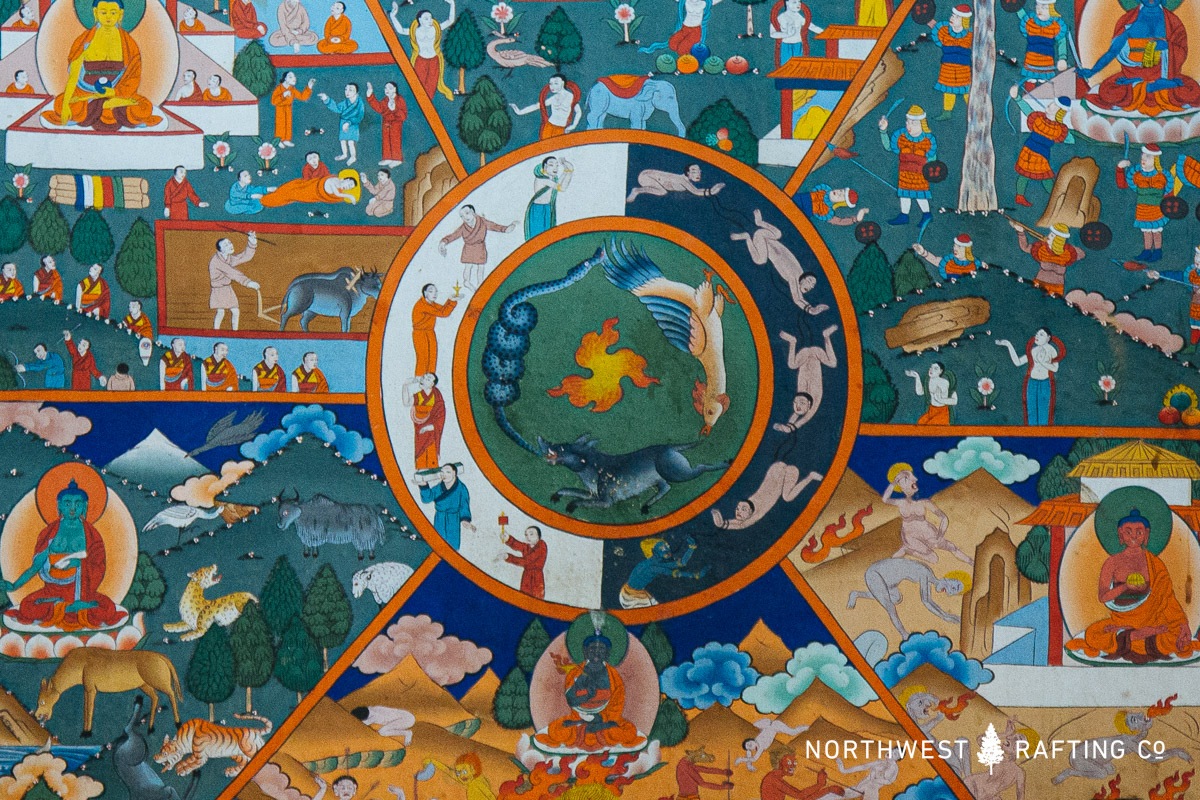
Let’s start with the innermost circle of the wheel, the smallest and seemingly most simple layer. There are three figures: a rooster, snake, and pig, chasing one another. These three figures represent the three poisons, the perpetuating root of all suffering. The rooster represents attachment, or greed. The pig represents ignorance. The snake represents aversion, or anger. Attachment sustains ignorance which feeds aversion. Then anger and aversion lead us to attachment, and the cycle of the three poisons continue. This circle, which shows the cycle of the three poisons, is at the center of the more intricate layers of The Wheel of Life because, without these three poisons, the other cycles of the wheel would simply not be.
Karma
The next cycle represents karma, which is essentially the fundamental rule that there is cause and effect in the world. Good actions bring goodness in the world, and bad actions generate negativity. Even within our own minds, positive thinking allows for a lighter view of the world, and criticality stains our view of everything around us. The image representing karma shows people either ascending to the “good” realms or descending into the “bad” realms. Karma is drawn as a constantly spinning wheel, meaning that ascension into a pleasurable realm is not permanent, and neither is the descent into a negative realm. As long as we are trapped within the cycle of the Wheel of Life, we will cycle in and out of both the good and the bad.
The Six Realms
The next layers are the six realms. Within the cycles of birth and rebirth, depending on one’s karma, one will be born into one of the six realms, which each come with their own fundamental conditions. The three realms at the top are generally considered the good realms, and the three realms at the bottom are generally considered the bad realms. At the top, there is the human realm, the god realm, and the demigod realm.
The God Realm
The god realm seems to be the most pleasurable, with every need being met, and the gods are able to live without suffering. However, there is a catch to the god realm; when you’re in a state of perpetual bliss, you are attached to that bliss, and often live your entire life in that realm without considering the dharma, or the teachings of buddhism.
The Demi-god realm
The demi-god realm is generally pleasurable, but the demigods are often jealous of the gods. Often, there is a tree, whose trunk and roots are in the demigod realm, but whose fruits grow in the god realm and are enjoyed by the gods. While the demigods generally live a pretty chill existence, they’re jealous of the gods and have a tendency to wage war against the gods or each other. Thus, the demigods tend to also live a life of suffering. Even pleasure is suffering.
The Human Realm
The human realm is where one can experience pleasure and pain; there is fighting, love making, friends, hunger, etc…The human realm is the only realm where one can focus on the dharma, which is the only way to reach enlightenment and escape the Wheel of Life-we’ll get to that part soon.
Next are the three bad realms
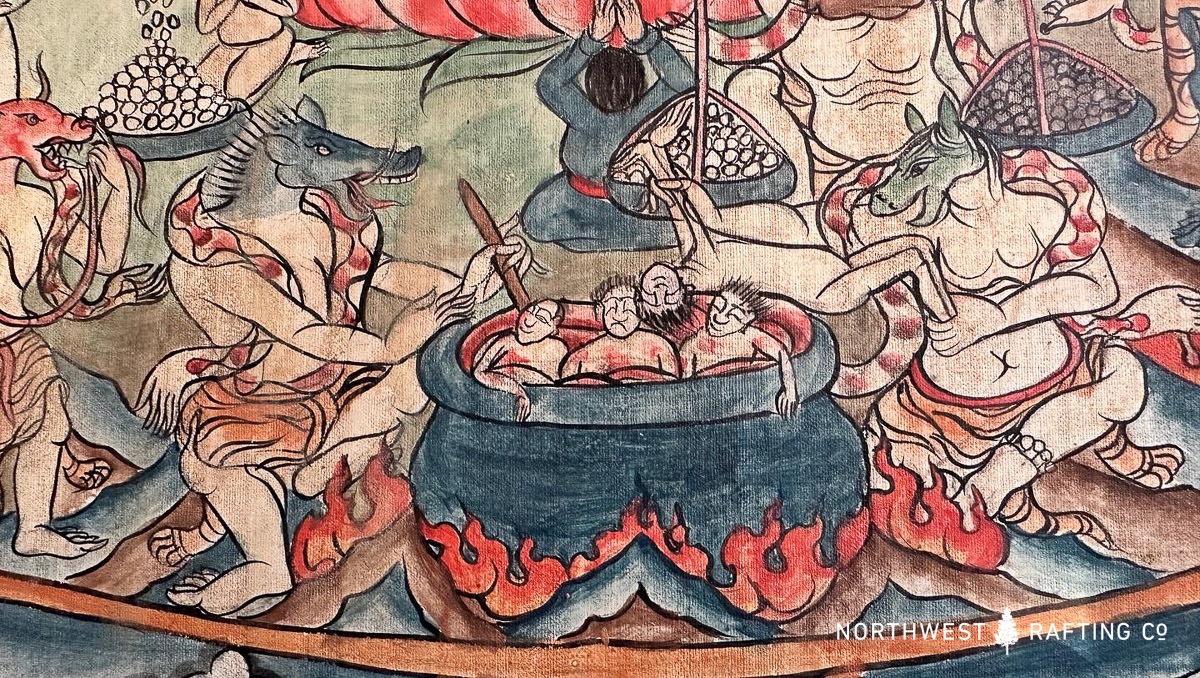
Hell
There’s hell, which consists of hot and cold hell. Yama rules hell, and there is a lot of torture and various forms of suffering. Hell is where anyone with particularly bad karma goes.
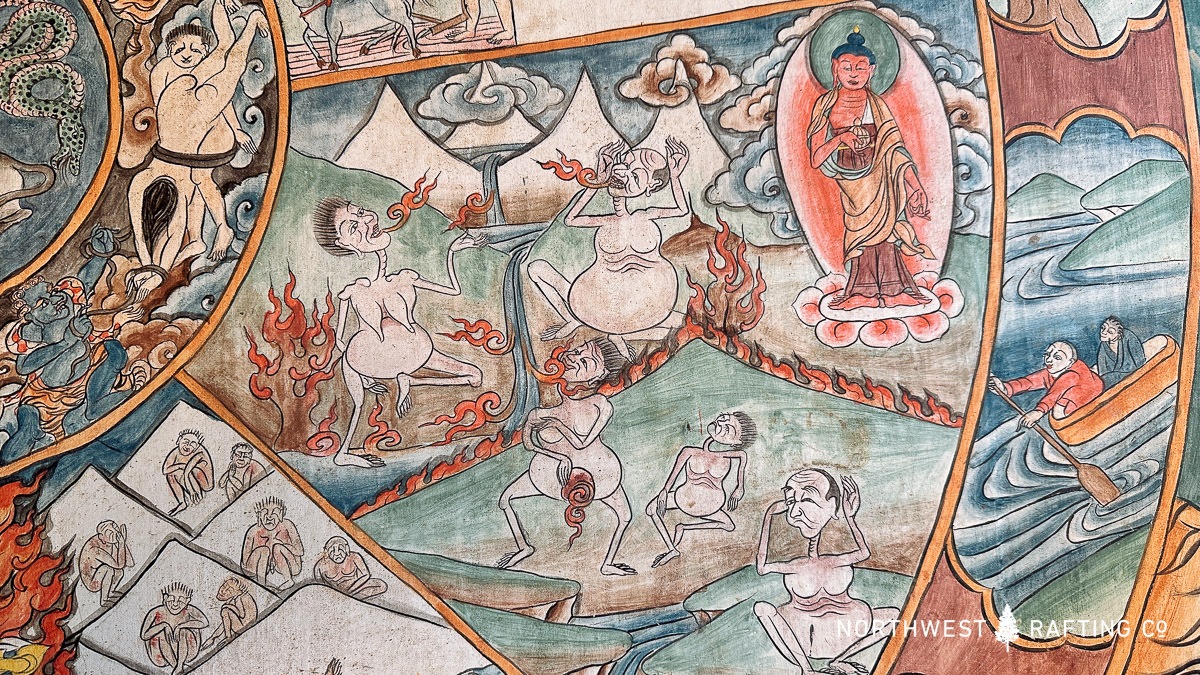
The Hungry Ghost Realm
Then, there is the realm of the hungry ghost, often reserved for those who have allowed greed to rule their life, those who always want more and more. In the realm of the hungry ghost, everyone has a very large belly and is incredibly hungry, but they cannot eat anything because their throats are so small.
The Animal Realm
Then, there is the animal realm, where beings live in ignorance, constantly pursuing the basic needs of survival and therefore fighting over basic resources. Any beings generated karma in these six realms determines the realm they will end up in the next rebirth, the next cycle. It’s important to know that even though there are good and bad realms, all six of the realms are ruled and defined by suffering, which is only escapable by eradicating the three poisons and therefore breaking loose of cyclical karma.
The Twelve Dependent Links
The final layer of the wheel are the twelve dependent links. These twelve zones are meant to illustrate how exactly the three poisons lead to a cycle of karma which leads to constant birth and rebirth in realms that are defined by suffering. Each of the twelve links is a stage of being that can be experienced over the course of a lifetime or in different lifetimes.
The critical message is that each stage leads to the other stages; the twelve links illustrate interdependency of stages of existence, for example that ignorance (symbolized in the painting as a blind man) leads to consciousness (the monkey by a fruit tree), or how attachment (picking fruit) leads to contact and feeling (the couple in each other’s arms) which sets the conditions of birth (this one is easy, a woman giving birth to a baby). If one can start to understand how each stage leads to the other stages, one can start to escape the cycle.
Outside the Wheel
Finally, the entire wheel is held by the God of Death, showing that the entire cycle is impermanent, and every stage or aspect of the cycle is also impermanent. Standing outside the Wheel of Life and Yama, is Buddha, showing that there is the possibility of freedom from the unrelenting cycles. The only way to escape the perpetual suffering, within this lifetime and across multiple lifetimes of birth and rebirth, is by stripping away the three root poisons, which will lead to karma ceasing to trap us in a constant cycle, which will allow us to move beyond the six realms and into enlightenment.
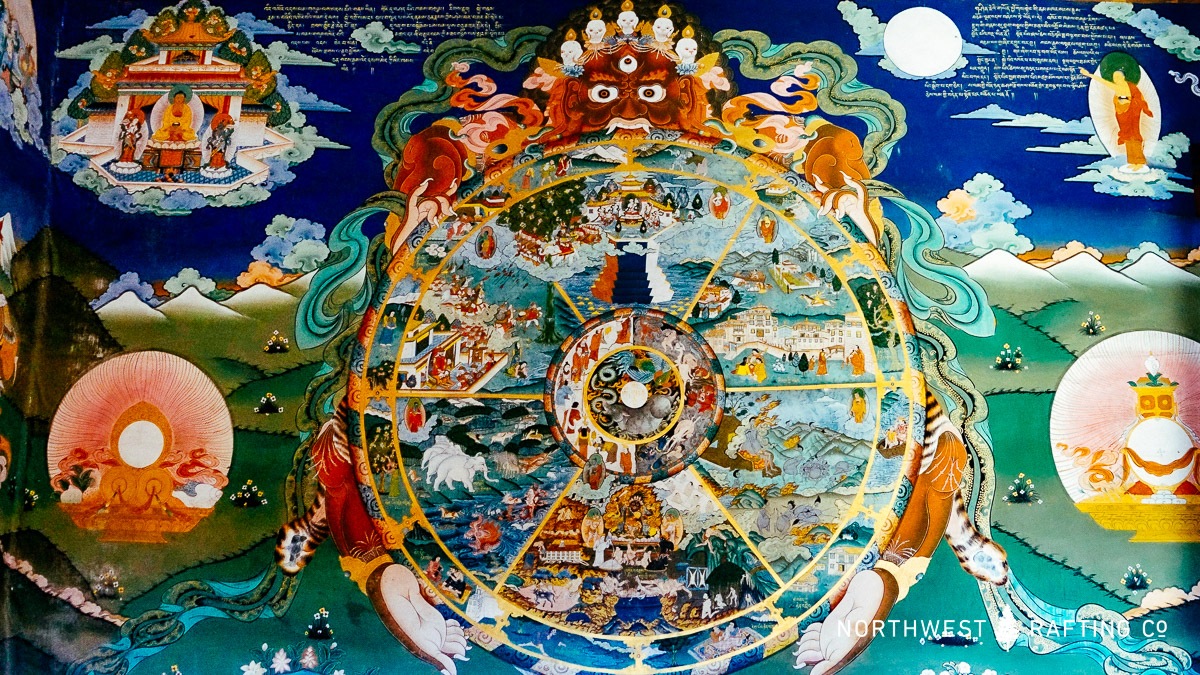
It’s a lot to take in; there are many details and messages, and there are a lot of details I still don’t understand or see how they’re connected. Even if all the details are too much to take in, the cyclical and impermanent nature of this existence, the connection between all beings, and the cause of effect nature of life are illustrated clearly. The Wheel of Life, standing proud at the entrance of nearly every temple, serves as a reminder of its essential teachings to everyone who passes.